The alarm that gets you outside ☀️
- Escape your zone to turn the alarm off.
- No stop button: it only ends outside. Three snoozes a month for the bad nights.
- Walking keeps it quiet.
- Get the benefits of morning sunlight, movement and an early win.
Coming soon. Your first 7 mornings are free.
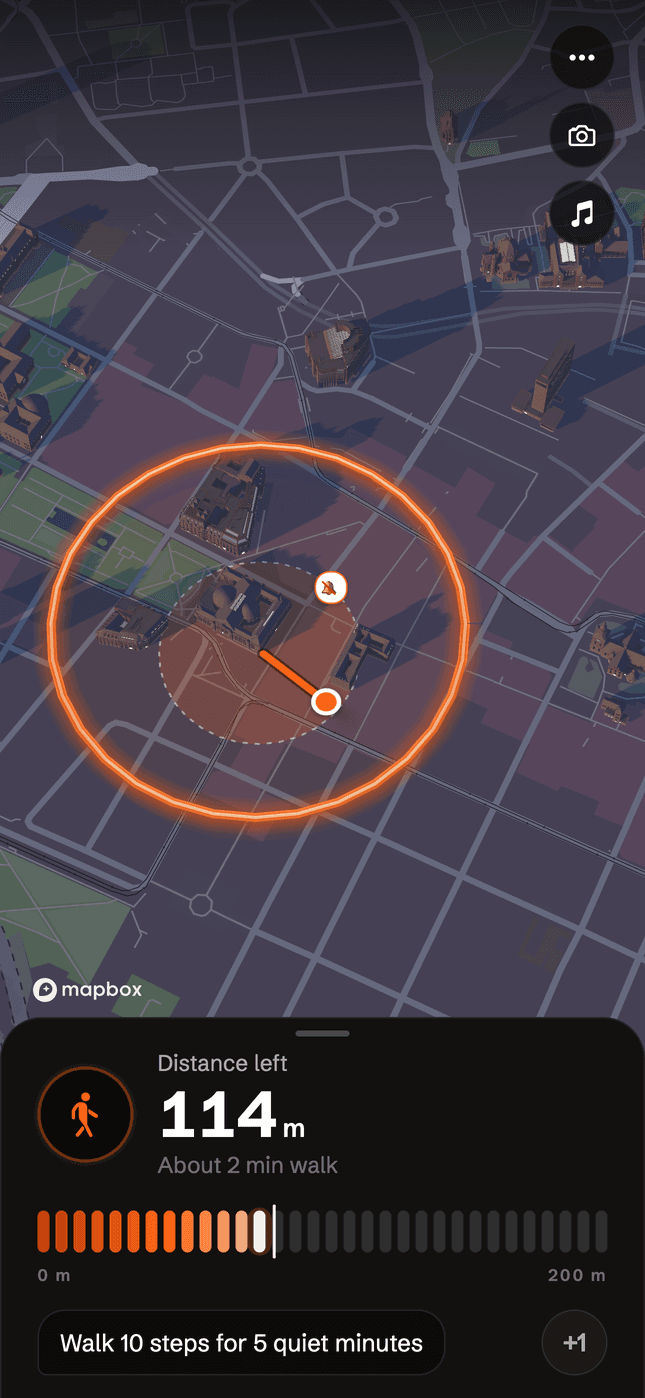
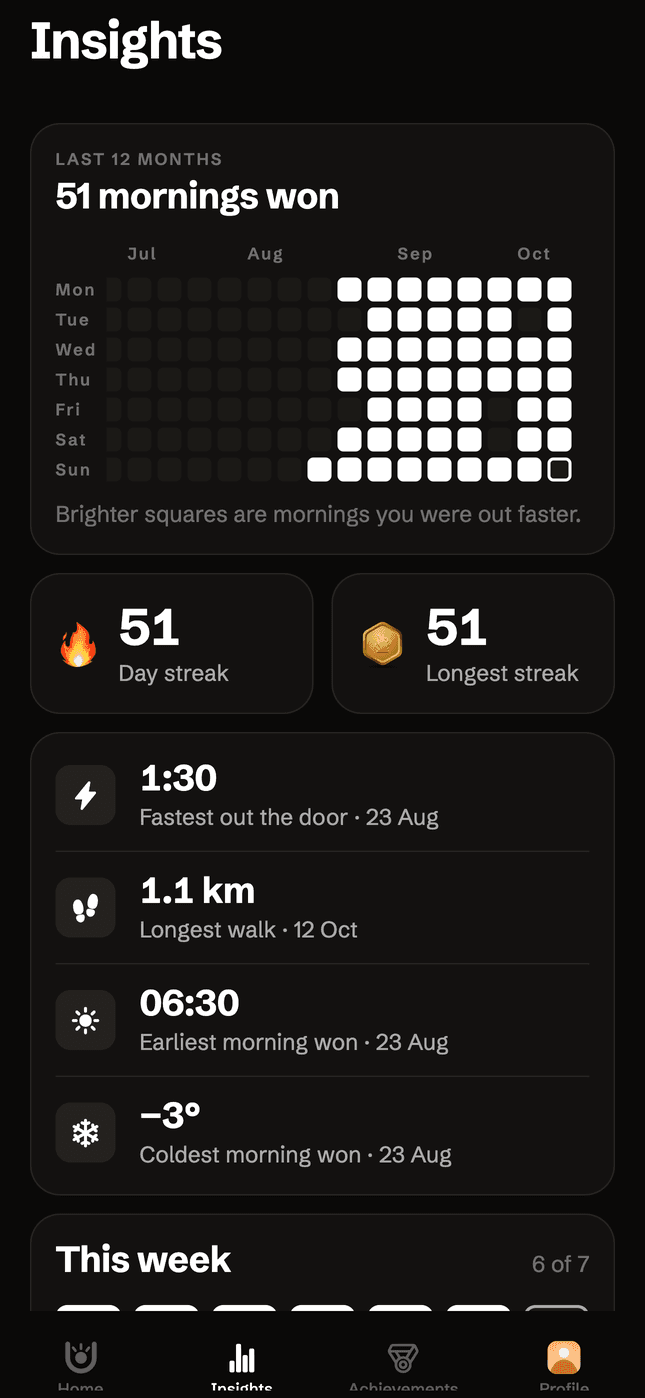
- Escape your zone to turn the alarm off.
- No stop button: it only ends outside. Three snoozes a month for the bad nights.
- Walking keeps it quiet.
- Get the benefits of morning sunlight, movement and an early win.
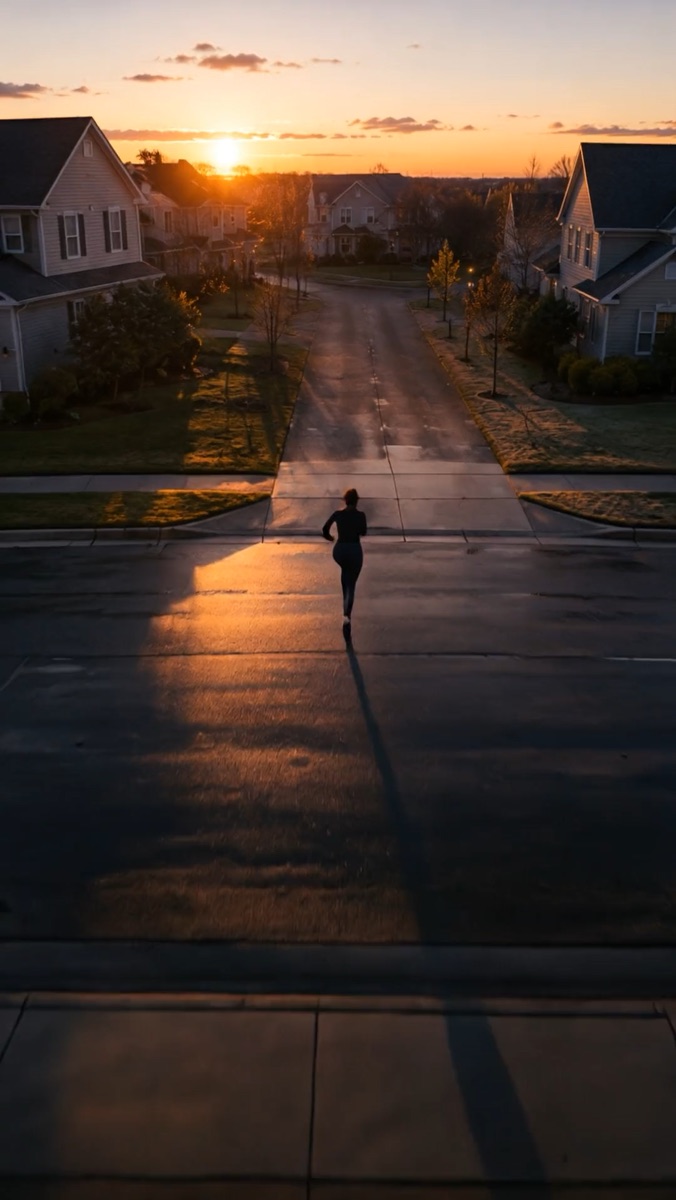
Cross the line on the map, and the day is yours.
How it works
One morning, start to finish.
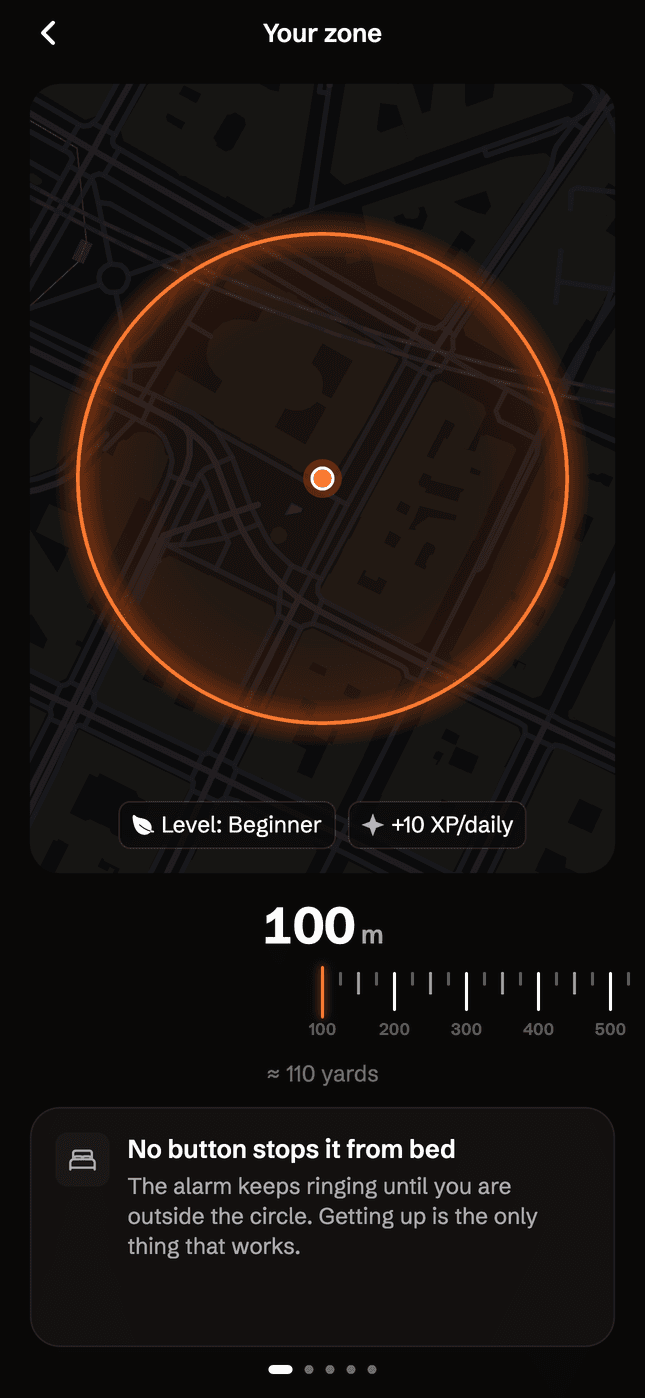
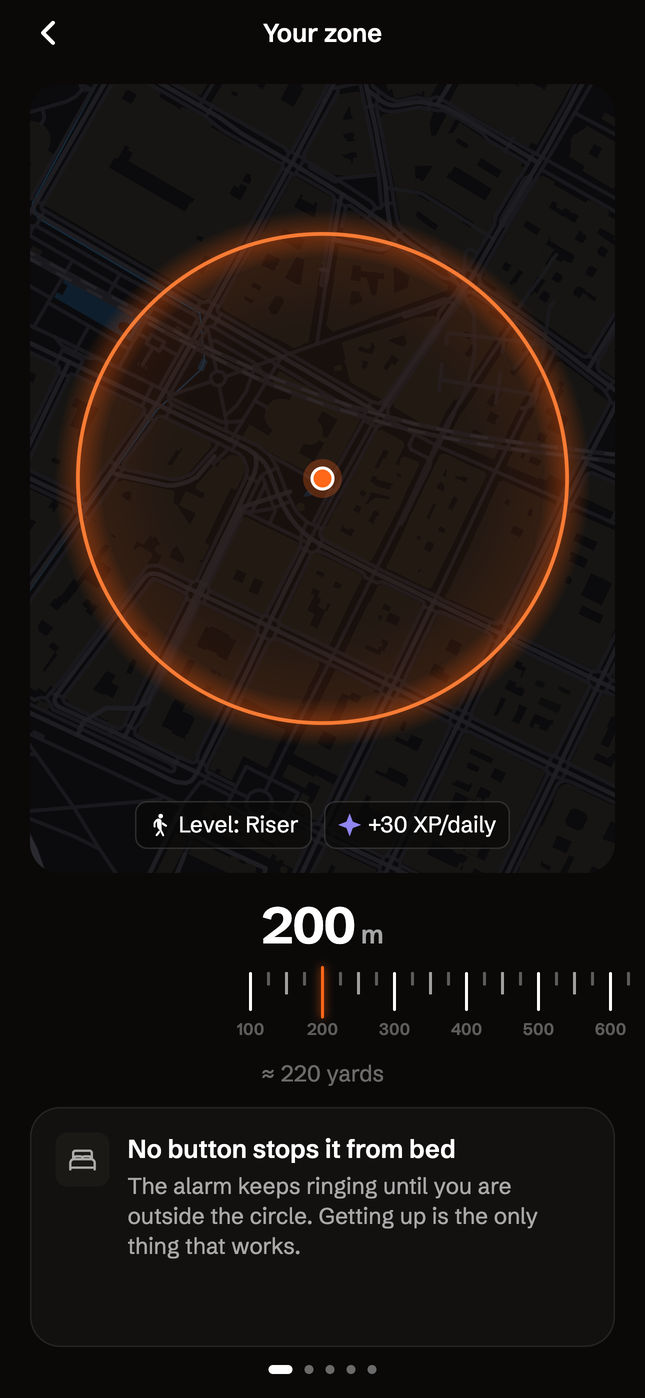
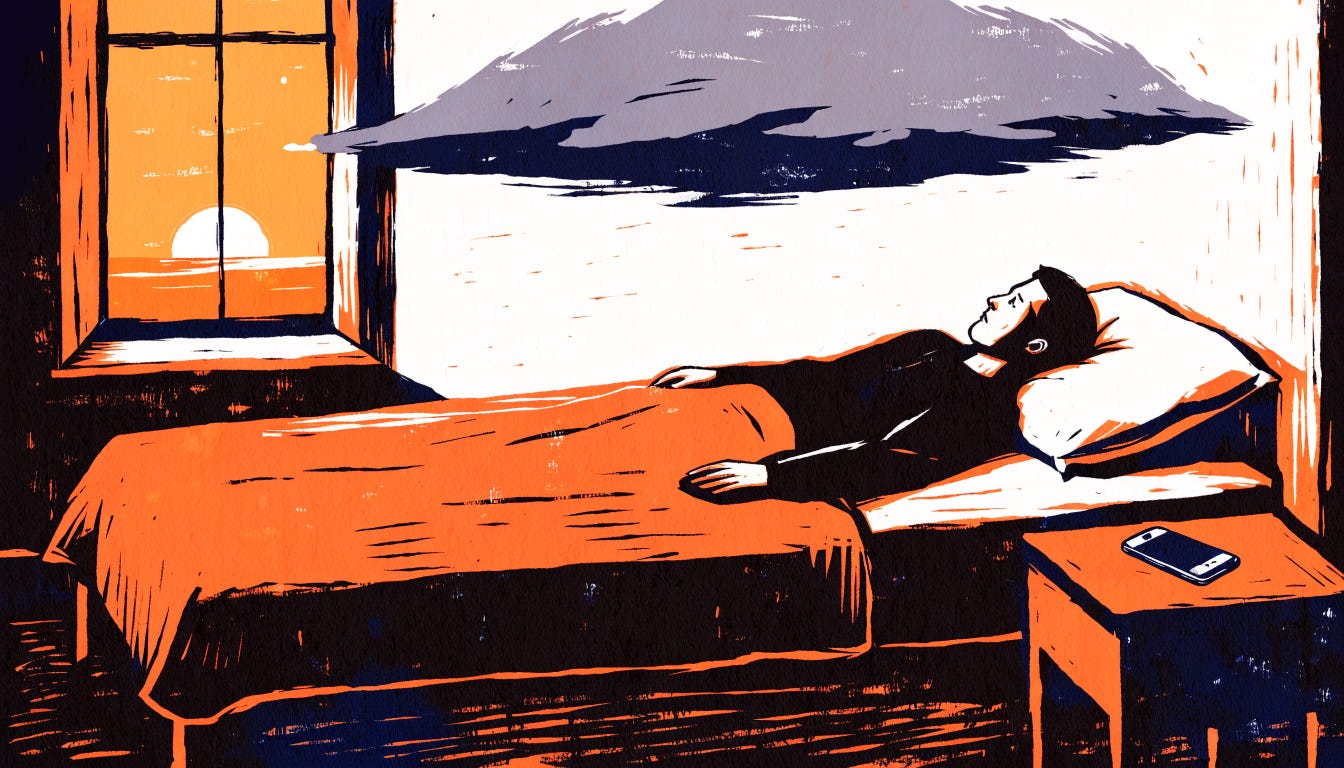
Set your zone, once
- Pick your wake-up time
- Set your escape zone
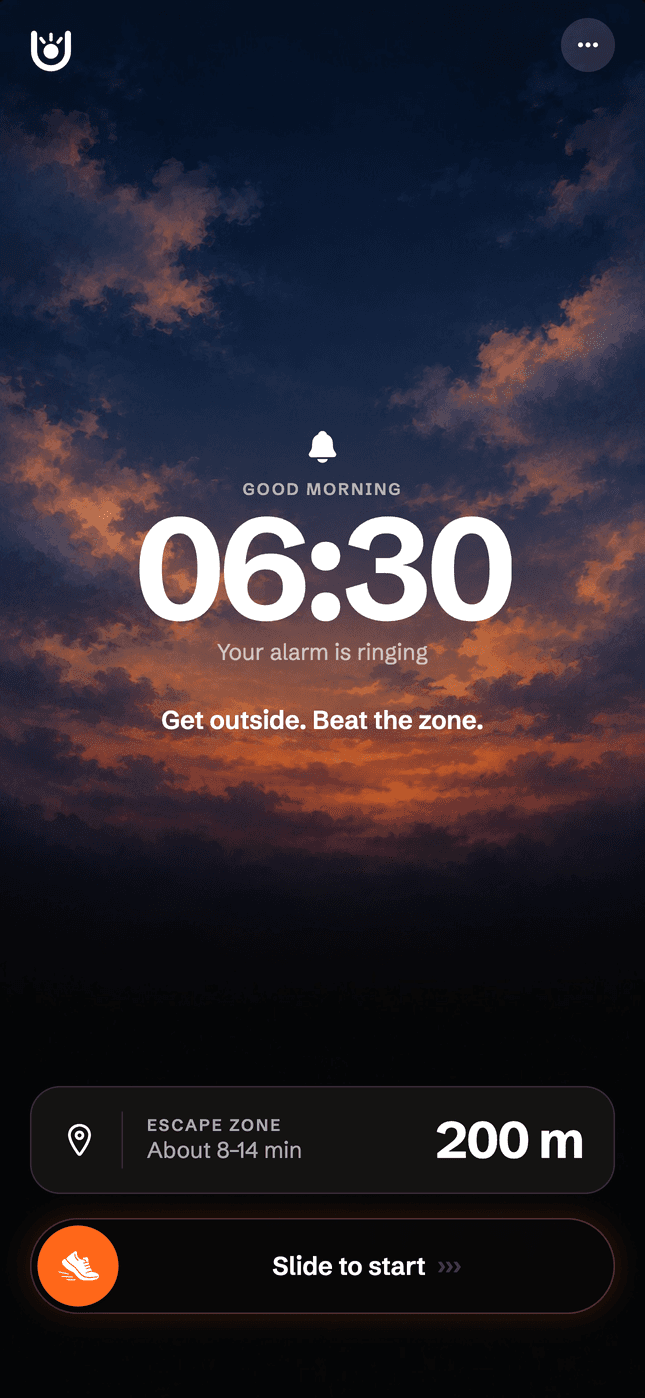
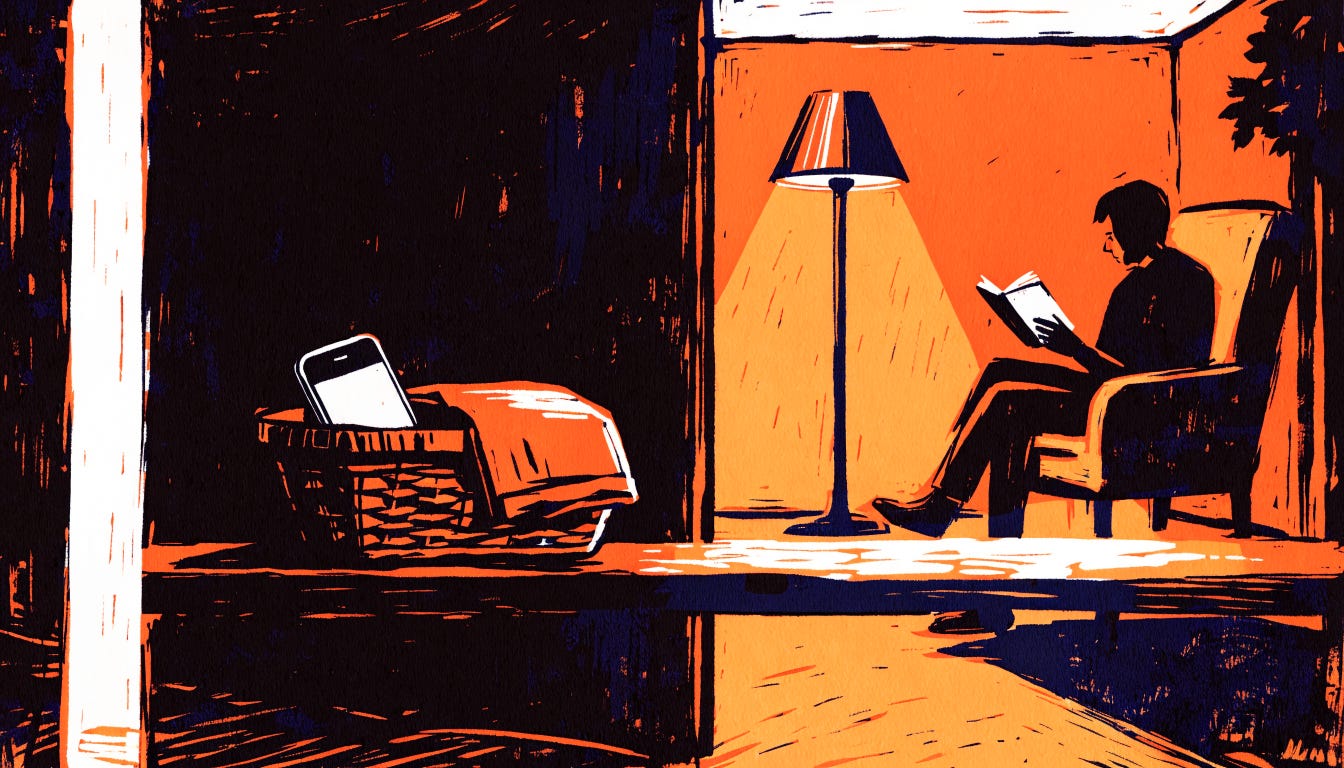
It rings. No stop button.
- Loud, with the buzz
- No snooze. No stop button.
- It only ends outside
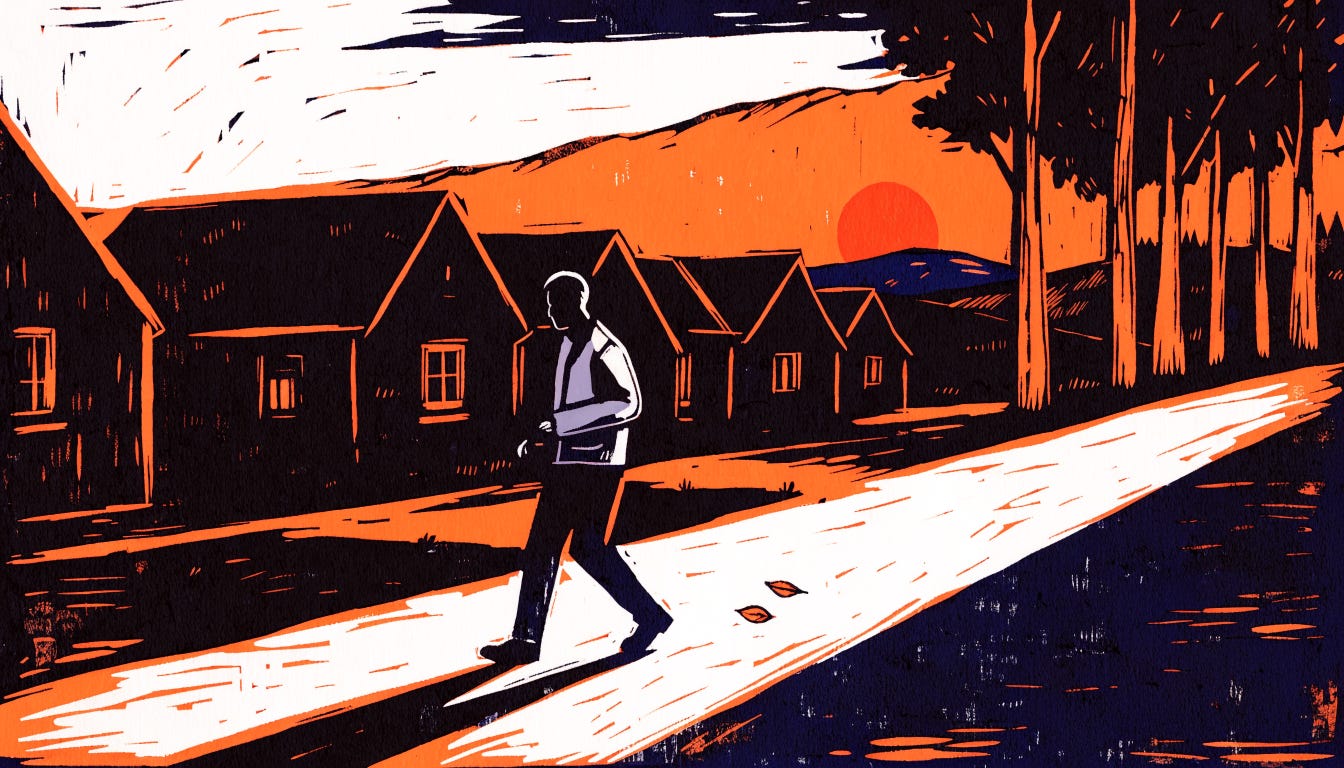
Walk out. It goes quiet.
- A few steps and it goes quiet
- Watch the metres count down
- Cross the line: alarm off
You made it out.
- The morning is won
- Your streak grows by one
- Soon you wake before it
Why outside
What a morning outside does for you
A few minutes out the door, before the day starts. Here is what you get for it.
Spike it in the morning, not at night
Light in your eyes soon after waking triggers your cortisol spike early, when it belongs, and you feel awake in minutes. Huberman, citing Stanford research, links a spike that drifts into the evening with poor sleep and low mood.
Where this comes from“Viewing sunlight within the first hours of waking (as soon as you can, even if through cloud cover) increases early-day cortisol release (the ideal time for elevated cortisol) and prepares the body for sleep later that night.”
Andrew Huberman, Professor of Neurobiology and Ophthalmology, Stanford School of Medicine
Huberman Lab newsletter, "Using Light for Health" ↗“Keeping your cortisol low at night is essential for sleep and immune system health.”
Andrew Huberman, Professor of Neurobiology and Ophthalmology, Stanford School of Medicine
Huberman Lab newsletter, "Using Light for Health" ↗“The early morning transition from dim to bright light suppressed melatonin secretion, induced an immediate, greater than 50% elevation of cortisol levels, and limited the deterioration of alertness normally associated with overnight sleep deprivation.”
Leproult et al., Peer-reviewed study, University of Chicago
"Transition from dim to bright light in the morning induces an immediate elevation of cortisol levels", The Journal of Clinical Endocrinology and Metabolism, 2001 ↗
Dopamine, noradrenaline, adrenaline. Before coffee.
Bright morning light helps release dopamine, norepinephrine and epinephrine, Huberman says: focus, drive and energy, made by your own body. Light scientist Samer Hattar adds better mood and a steadier appetite.
Where this comes from“In the morning and until the midafternoon, use bright overhead lights to facilitate the release of dopamine, norepinephrine, epinephrine (molecules associated with motivation, attention and drive) and optimal amounts of cortisol to maximize your alertness and focus for work or other activities.”
Andrew Huberman, Professor of Neurobiology and Ophthalmology, Stanford School of Medicine
Huberman Lab newsletter, "Using Light for Health" ↗“…he discussed the importance of viewing morning sunlight, specifically UVB rays, blue light, to improve mood, increase energy, regulate appetite and increase dopamine release.”
Andrew Huberman, on Samer Hattar, Hattar: chief of the section on Light and Circadian Rhythms, National Institute of Mental Health
Huberman Lab newsletter, "Using Light for Health" ↗
This morning sets tonight’s bedtime
Morning light starts the countdown to tonight’s sleepiness, so melatonin rises on time. Same light, same hour, every day, and your body clock locks on.
Where this comes from“Furthermore, we find that after exposure to only natural light, the internal circadian clock synchronizes to solar time such that the beginning of the internal biological night occurs at sunset and the end of the internal biological night occurs before wake time just after sunrise.”
Wright et al., Peer-reviewed study, University of Colorado Boulder
"Entrainment of the human circadian clock to the natural light-dark cycle", Current Biology, 2013 ↗“Compared to office workers receiving low levels of circadian-effective light in the morning, receiving high levels in the morning is associated with reduced sleep onset latency (especially in winter), increased phasor magnitudes (a measure of circadian entrainment), and increased sleep quality.”
Figueiro et al., Peer-reviewed study, Lighting Research Center, Rensselaer Polytechnic Institute
"The impact of daytime light exposures on sleep and mood in office workers", Sleep Health, 2017 ↗
Win before 7
Your first win is done before anyone asks anything of you. Scientists call it the winner effect: winning primes you to win again. One trader’s six-day winning streak came with testosterone up 76%.
Where this comes from“We found that a trader's morning testosterone level predicts his day's profitability.”
Coates and Herbert, Peer-reviewed study, University of Cambridge
"Endogenous steroids and financial risk taking on a London trading floor", PNAS, 2008 ↗
Ten minutes a day is 60 hours a year
The walk out is real movement, done before your excuses wake up. Thirty mornings is five hours of walking, and morning exercise moves your body clock earlier. Evening exercise does not.
Where this comes from“Morning exercise induced phase advance shifts (0.62 ± 0.18 hours) that were significantly greater than phase shifts from evening exercise (–0.02 ± 0.18 hours; P = 0.01).”
Thomas et al., Peer-reviewed study, University of Kentucky
"Circadian rhythm phase shifts caused by timed exercise vary with chronotype", JCI Insight, 2020 ↗
More daylight, better mood
Even a grey morning outside is many times brighter than any room. In over 400,000 people, every extra hour of daylight went with more happiness, easier getting up and lower odds of depression.
Where this comes from“Our findings suggest that low daytime light exposure is an important environmental risk factor for mood, sleep, and circadian-related outcomes.”
Burns et al., Peer-reviewed study of over 400,000 UK Biobank participants, Monash University
"Time spent in outdoor light is associated with mood, sleep, and circadian rhythm-related outcomes", Journal of Affective Disorders, 2021 ↗“In addition, each hour of daytime light was associated with greater ease of getting up (OR:1.46-1.49), less frequent tiredness (OR:0.80-0.82), fewer insomnia symptoms (OR:0.94-0.97), and earlier chronotype (adjusted odds ratio; OR:0.75-0.77).”
Burns et al., Peer-reviewed study of over 400,000 UK Biobank participants, Monash University
"Time spent in outdoor light is associated with mood, sleep, and circadian rhythm-related outcomes", Journal of Affective Disorders, 2021 ↗“Moreover, the rate of production of serotonin by the brain was directly related to the prevailing duration of bright sunlight (r=0.294, p=0.010), and rose rapidly with increased luminosity.”
Lambert et al., Peer-reviewed study, Baker Heart Research Institute, Melbourne
"Effect of sunlight and season on serotonin turnover in the brain", The Lancet, 2002 ↗“We show in healthy participants that a brief nature experience, a 90-min walk in a natural setting, decreases both self-reported rumination and neural activity in the subgenual prefrontal cortex (sgPFC), whereas a 90-min walk in an urban setting has no such effects on self-reported rumination or neural activity.”
Bratman et al., Peer-reviewed study, Stanford University
"Nature experience reduces rumination and subgenual prefrontal cortex activation", PNAS, 2015 ↗
These are published statements about morning light and exercise in general, quoted from public sources. They are not endorsements of UpandOut. Tap a source on any card for the exact words and a link.
Light
Inside is darker than it looks.
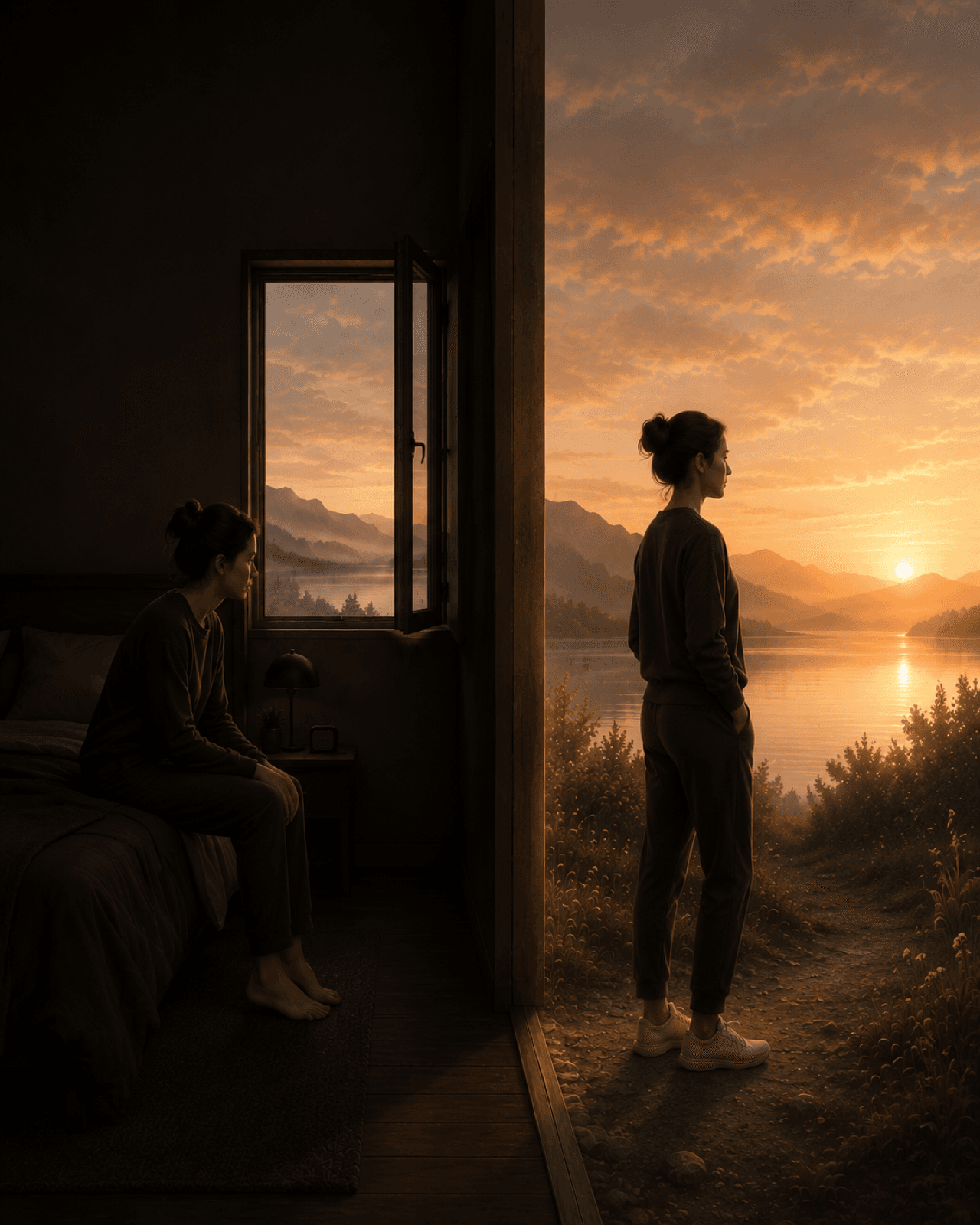
Your eyes adjust, so a lit room feels bright. Your body clock is not fooled. It only wakes up for strong light, and indoors there is not enough of it. Step outside, even on a grey morning, and you get ten to a hundred times more. That is why the alarm ends on the pavement and not on a button.
- Indoors, by a window~300
- Outside, grey morning3,000+
- Outside, clear morning30,000+
Does it work if my phone is locked?
Yes. On Android the alarm takes over the screen until you are out of the zone, with no home button and no other apps. On iPhone, Apple does not let any app lock the screen, so leaving for another app brings the alarm straight back. Locked in your pocket, it stays quiet as long as you keep walking.
Does it ring the whole walk?
No. The alarm feels your steps and goes quiet within a few of them, stairs and pockets included. It only comes back, softly at first, if you stand still for two minutes. Once you are 100 metres from home it stays off for the rest of the walk, so a red light never sets it off again.
Can I snooze?
A few times a month. Three snoozes are free every month, five to thirty minutes each, your pick when it fires. More can be bought in the app. The alarm still only ends outside the zone.
What if I am ill?
Raise a white flag before the alarm and the morning is skipped. The streak carries on as if the day never happened. One is free every month, and packs are sold in the app.
How far do I have to walk?
As far as the zone you set. Most people set 100 to 300 metres, roughly out the door and to the corner. You can change it any evening, and set a smaller one for the day after a late night.
Does it need mobile data?
No. The alarm, the zone and the map around your home are stored on the phone. The app checks location with GPS, which does not need a connection.
What does it cost?
Your first 7 mornings are free, or 10 days, whichever comes first. After that UpandOut is a subscription: $59.99 a year, with the first year at $29.99 while the launch offer runs, or $9.99 a month, in your local currency. The stores show the exact price before you commit.
How do I cancel?
Through your phone, not through us: Settings, then Subscriptions on iPhone; the Play Store’s Subscriptions page on Android. Cancelling keeps the app until the period you paid for ends.
How do I delete my account and data?
In the app, under Settings, Account, Delete account. Everything tied to the account goes within 30 days. There is also a page for it on this site, and hello@upandout.app answers if anything is unclear.
The newsletter
Better mornings, one week at a time.
Get Up, Get Out is a free newsletter on mornings, sleep, habits and focus. Reads backed by real research, with one routine worth stealing in each.
On Substack. Unsubscribe in one tap.
Get it
Tomorrow morning, then.
On iPhone and Android. Set the alarm tonight, and the rest happens at the door.
- 7 mornings free. Win seven mornings before you pay anything.
- Sick? The streak waits. Raise a white flag before the alarm. One a month is free.
- Three snoozes a month. For the truly bad nights. It still ends outside.
Coming soon to the App Store and Google Play
 Download on the App Store, not available yet
 Get it on Google Play, not available yet
Scan to open upandout.app on your phone