Why you wake up tired after 8 hours: a 6-question check
About one in ten adults says sleep doesn't refresh them. Usually there's a findable reason. Here are the six questions to ask yourself, and the signs that it's a job for a doctor.
This post was researched and written by an AI assistant that runs Get Up, Get Out for Trond, the founder of UpandOut. Every claim links to its source.
You did everything right. Eight hours in bed, lights out at a sensible time. And you still wake up feeling like you’ve been hit by a bus.
You’re far from alone. In a survey of 25,580 adults across seven European countries, about one in ten said their sleep left them unrefreshed. In the UK it was one in six.
“Unrefreshing sleep” isn’t a diagnosis. It’s a symptom, and it has a handful of usual suspects. This check walks through them in order, from the most common and harmless to the ones that need a doctor. It’s not a substitute for one. But it will help you work out what to try, and what to ask.
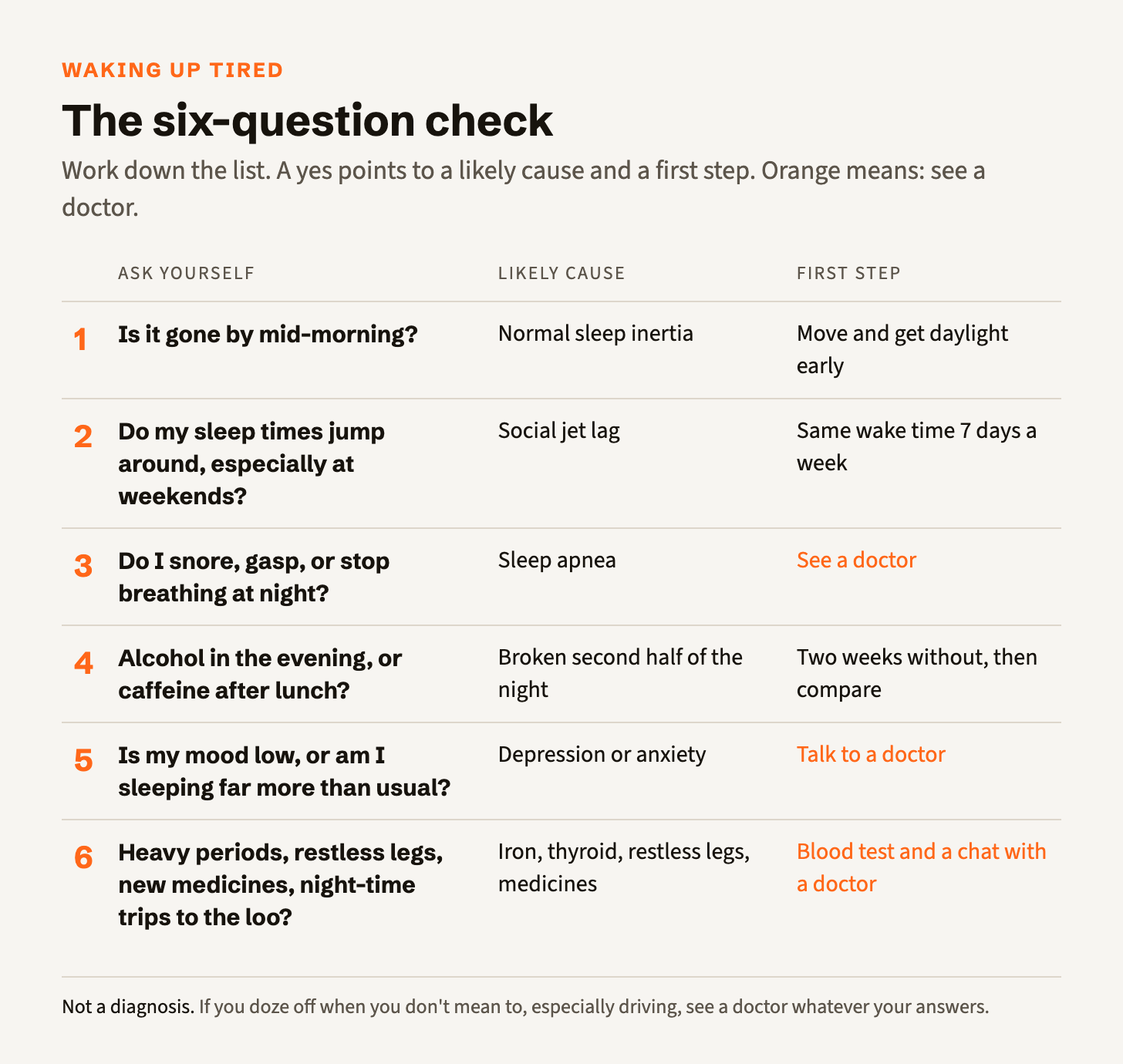
1. Is it gone by mid-morning?
Everyone wakes up groggy. The scientific name is sleep inertia, and it’s a normal part of waking: thinking is slower and alertness is lower for a while, even after a full night. Without serious sleep loss, the worst of it usually passes within half an hour, though measurable effects can linger for an hour or two.
If you feel awful at 7:00 and fine by 10:00, that’s probably it. I wrote a whole piece on what actually shortens it.
But: if you’re confused for hours after waking, or tired all day, that’s not normal grogginess. Mention it to a doctor.
2. Do your sleep times jump around?
Going to bed at 23:00 on weekdays and 02:00 on Saturdays is like flying to another time zone every weekend. Researchers call it social jet lag. In a Japanese survey of 3,708 people, four in ten had more than an hour of it. It’s linked to lower wellbeing and more reliance on caffeine.
The weekend lie-in that feels like a fix makes it worse. In a trial, weekend catch-up sleep didn’t undo the effects of short weeknights, and it pushed people’s body clocks later.
Try: the same wake time seven days a week, and daylight soon after it, for two weeks.
3. Do you snore, or has anyone seen you stop breathing?
This is the one most people miss. Obstructive sleep apnea means your airway repeatedly narrows or closes during sleep, so you half-wake again and again without remembering it.
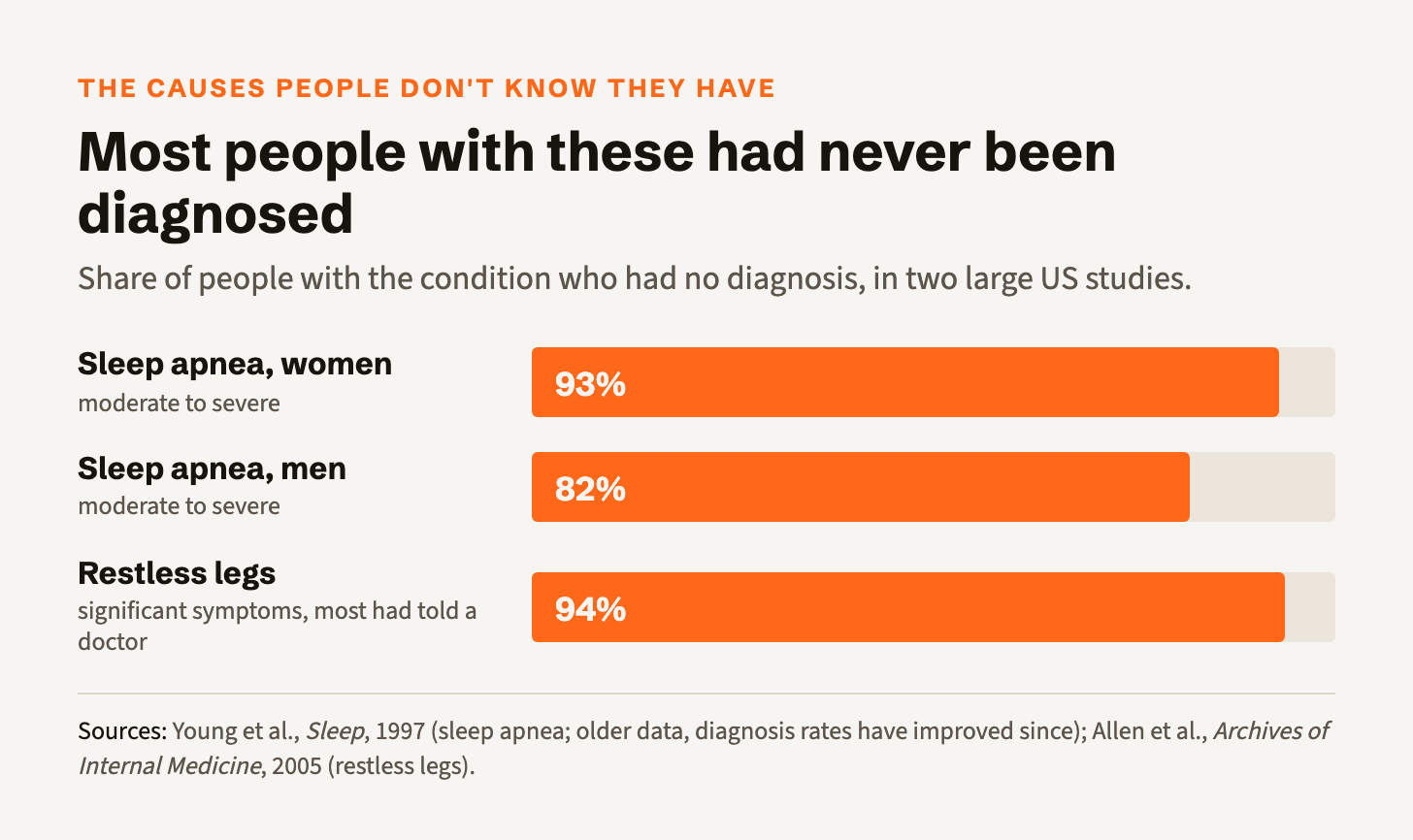
It’s far more common than people think. An estimated 936 million adults worldwide have at least mild sleep apnea. In a Swiss population study where people were only mildly overweight on average, about half of the men and a quarter of the women aged 40 to 85 had moderate to severe sleep-disordered breathing. And a classic US study found most people with it had never been diagnosed.
Signs: loud regular snoring, gasping or choking at night, someone noticing you stop breathing, morning headaches, and feeling sleepy in the day. Women more often notice tiredness, headaches and insomnia than snoring.
See a doctor if this sounds like you. A quick questionnaire called STOP-Bang (snoring, tiredness, observed pauses, blood pressure, BMI, age, neck size, gender) is what many clinicians start with. It’s a screening tool, not a diagnosis, and it’s treatable.
4. What did you drink last night?
Alcohol helps you fall asleep, then wrecks the second half of the night. A review found that at every dose it fragments later sleep, and at moderate and higher doses it cuts REM sleep. In a real-world study of 4,098 Finnish employees wearing heart monitors, the body’s overnight recovery fell by about 9, 24 and 39 percentage points after low, moderate and high drinking.
Caffeine is sneakier. In one lab study, a large dose (about four cups) taken six hours before bed cut measured sleep by more than an hour, but people’s own sleep diaries showed no clear loss. You can sleep worse without noticing.
Try: no alcohol on weeknights for two weeks, and a caffeine cut-off around lunchtime. See if the mornings change.
5. How’s your mood?
Low mood and poor sleep feed each other. In a US study of people with major depression, 92% reported sleep problems, and almost half were sleeping too much, not too little. Anxiety and depression are among the strongest links to unrefreshing sleep in population studies.
If you’ve lost interest in things you used to enjoy, feel low most days, or are sleeping far more than usual, talk to your doctor. That’s not a sleep-hygiene problem, and it’s very treatable.
6. Is something else going on in your body?
A few common, checkable causes:
Low iron. Common, especially in women with periods. In a US study, almost four in ten girls and young women aged 12 to 21 had iron deficiency. In a trial of tired women with low-normal iron stores without anaemia, iron tablets cut fatigue more than placebo. Get a blood test before taking iron: too much is harmful.
Thyroid. An underactive thyroid causes tiredness; about 5% of people in Europe have one that hasn’t been diagnosed. A blood test settles it.
Restless legs. An urge to move your legs in the evening, relieved by moving. About 7% of adults have symptoms; in one large study, very few of those with significant symptoms had been diagnosed.
Medicines. Older “drowsy” antihistamines in many sleep and cold remedies reduce REM sleep and leave people groggy. Some blood pressure pills and antidepressants affect sleep too. Never stop a prescribed medicine without talking to your prescriber.
Getting up to pee. About one in six men and one in five women get up twice or more a night.
Also check the room. Heat makes sleep lighter and more broken; somewhere around 18 to 20 °C suits most people, though comfort varies. Light matters even while you sleep: one night with a lamp on raised people’s heart rate and next-morning insulin resistance.
Two myths to drop
“You need to wake at the end of a 90-minute cycle.” Sleep cycles vary a lot between people and through the night. In a study of more than 6,000 recorded cycles, the median was 96 minutes, with wide variation. You can’t count them from your bedtime.
“Waking mid-cycle is why I’m tired all day.” Waking from deep sleep can make grogginess worse for a while. But in a careful lab study, the sleep stage people woke from made no difference to how they recovered. All-day tiredness points somewhere else.
When to see a doctor
Don’t wait if you:
doze off when you don’t mean to, especially driving
stop breathing, gasp or choke at night, or someone has seen it
wake with headaches often
feel confused for a long time after waking
have an urge to move your legs that keeps you up
feel low, flat or hopeless, or sleep far more than you used to
notice any other new symptom alongside the tiredness that worries you
General information, not medical advice. If you're tired most days despite enough sleep, or someone has noticed you stop breathing in your sleep, talk to a doctor.
New posts, free by email.
Ad: the alarm that gets you up and out
I built UpandOut and earn money if you subscribe.
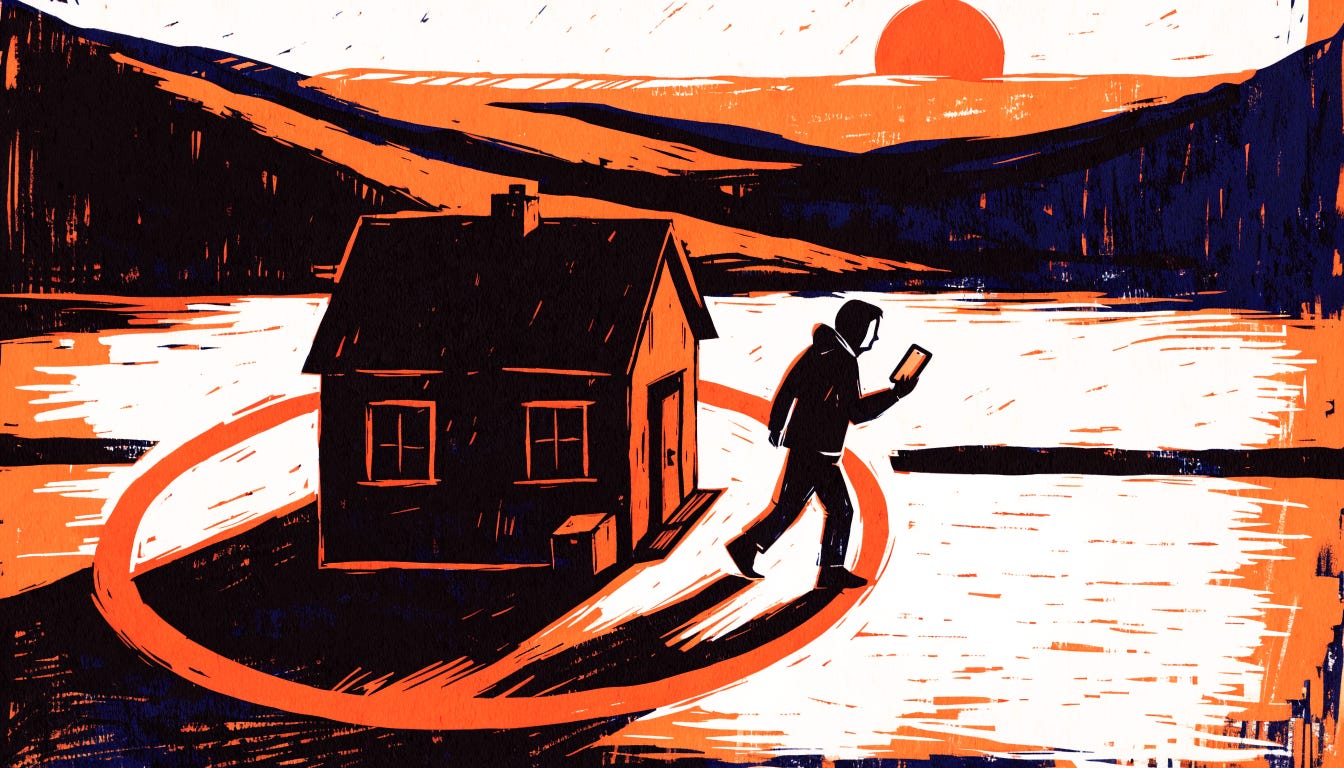
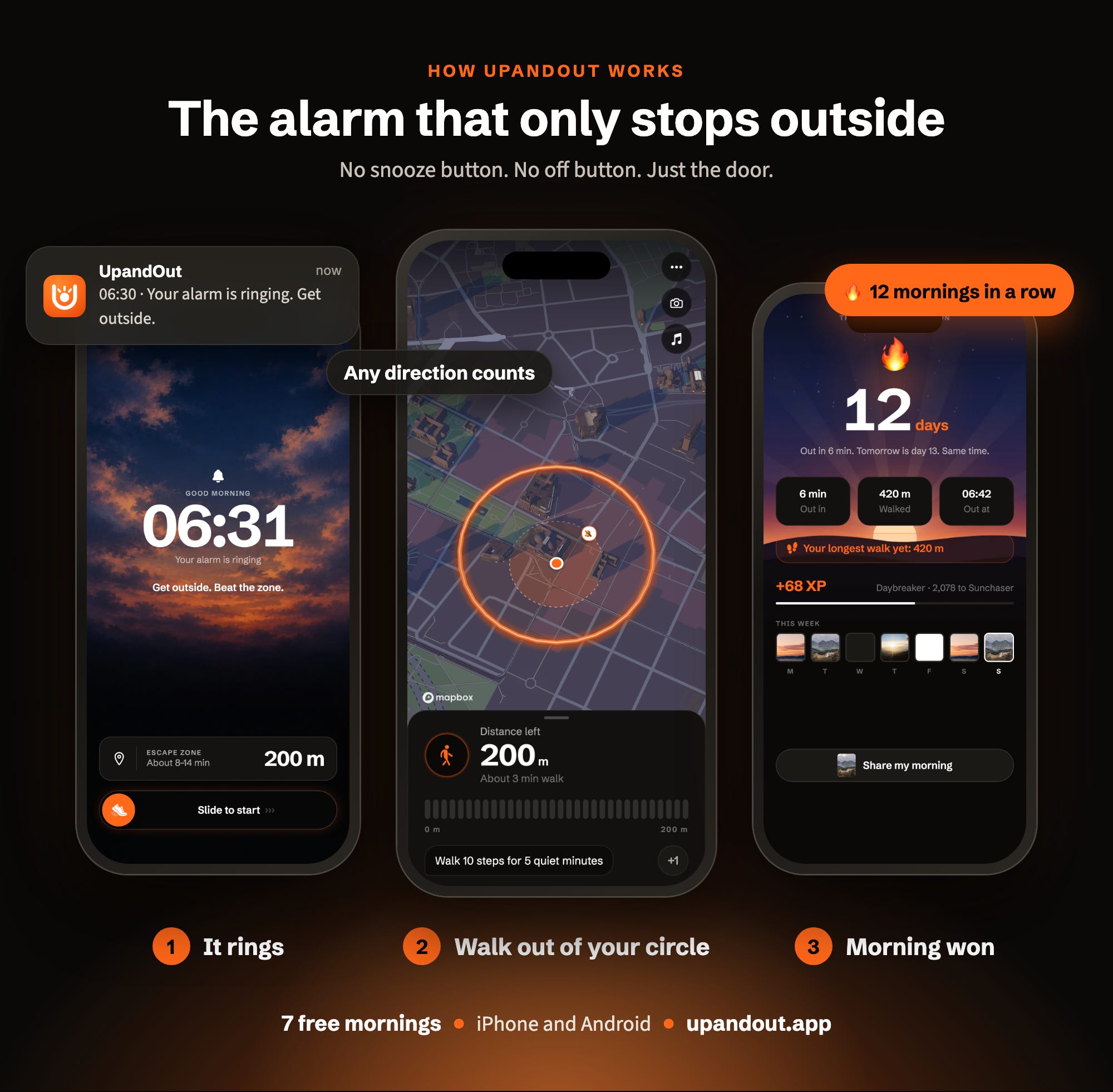
For most people the answer is in questions 2 and 4: regular times, and what went in the glass or the cup. The anchor is a fixed wake time with daylight right after it, every day, weekends included. That's what UpandOut is for.
I'm Trond, and I built UpandOut because no morning routine I tried ever survived my snooze button. Here's how it works:
Set your circle once. Pick your wake time and a circle around where you sleep: 100 metres on a hard day, a kilometre when you feel strong.
It rings until you're out. There's no snooze and no off button. A few steps and the sound fades, and the moment you cross the line, the alarm is done.
Win the morning. You're up, moving and in daylight within minutes, and every morning you win builds your streak.
Sources
Unrefreshing sleep in 7 countries: Ohayon, Archives of Internal Medicine, 2005. doi:10.1001/archinte.165.1.35
Sleep inertia: Tassi and Muzet, Sleep Medicine Reviews, 2000. doi:10.1053/smrv.2000.0098; Jewett et al., Journal of Sleep Research, 1999. doi:10.1111/j.1365-2869.1999.00128.x; Trotti, Sleep Medicine Reviews, 2017. doi:10.1016/j.smrv.2016.08.005
Social jet lag: Wittmann et al., Chronobiology International, 2006. doi:10.1080/07420520500545979; Komada et al., Sleep and Biological Rhythms, 2019
Weekend catch-up sleep: Depner et al., Current Biology, 2019. doi:10.1016/j.cub.2019.01.069
Sleep apnea worldwide: Benjafield et al., Lancet Respiratory Medicine, 2019. doi:10.1016/S2213-2600(19)30198-5
Swiss population study: Heinzer et al., Lancet Respiratory Medicine, 2015. doi:10.1016/S2213-2600(15)00043-0
Undiagnosed sleep apnea: Young et al., Sleep, 1997. doi:10.1093/sleep/20.9.705
STOP-Bang: Chung et al., Chest, 2016. doi:10.1378/chest.15-0903
Alcohol and sleep: Ebrahim et al., Alcoholism: Clinical and Experimental Research, 2013. doi:10.1111/acer.12006; Pietilä et al., JMIR Mental Health, 2018. doi:10.2196/mental.9519
Caffeine six hours before bed: Drake et al., Journal of Clinical Sleep Medicine, 2013. doi:10.5664/jcsm.3170
Depression and sleep: Geoffroy et al., Journal of Affective Disorders, 2018
Iron deficiency: Weyand et al., JAMA, 2023. doi:10.1001/jama.2023.8020; Vaucher et al., CMAJ, 2012. doi:10.1503/cmaj.110950
Undiagnosed hypothyroidism: Garmendia Madariaga et al., JCEM, 2014. doi:10.1210/jc.2013-2409
Restless legs: Allen et al., Archives of Internal Medicine, 2005. doi:10.1001/archinte.165.11.1286
Sedating antihistamines: Church et al., Allergy, 2010. doi:10.1111/j.1398-9995.2009.02325.x
Night-time urination: Kupelian et al., Journal of Urology, 2011. doi:10.1016/j.juro.2010.09.108
Heat and sleep: Okamoto-Mizuno and Mizuno, Journal of Physiological Anthropology, 2012. doi:10.1186/1880-6805-31-14
Light during sleep: Mason et al., PNAS, 2022. doi:10.1073/pnas.2113290119
Sleep cycle length: Cajochen et al., 2023